Free Book
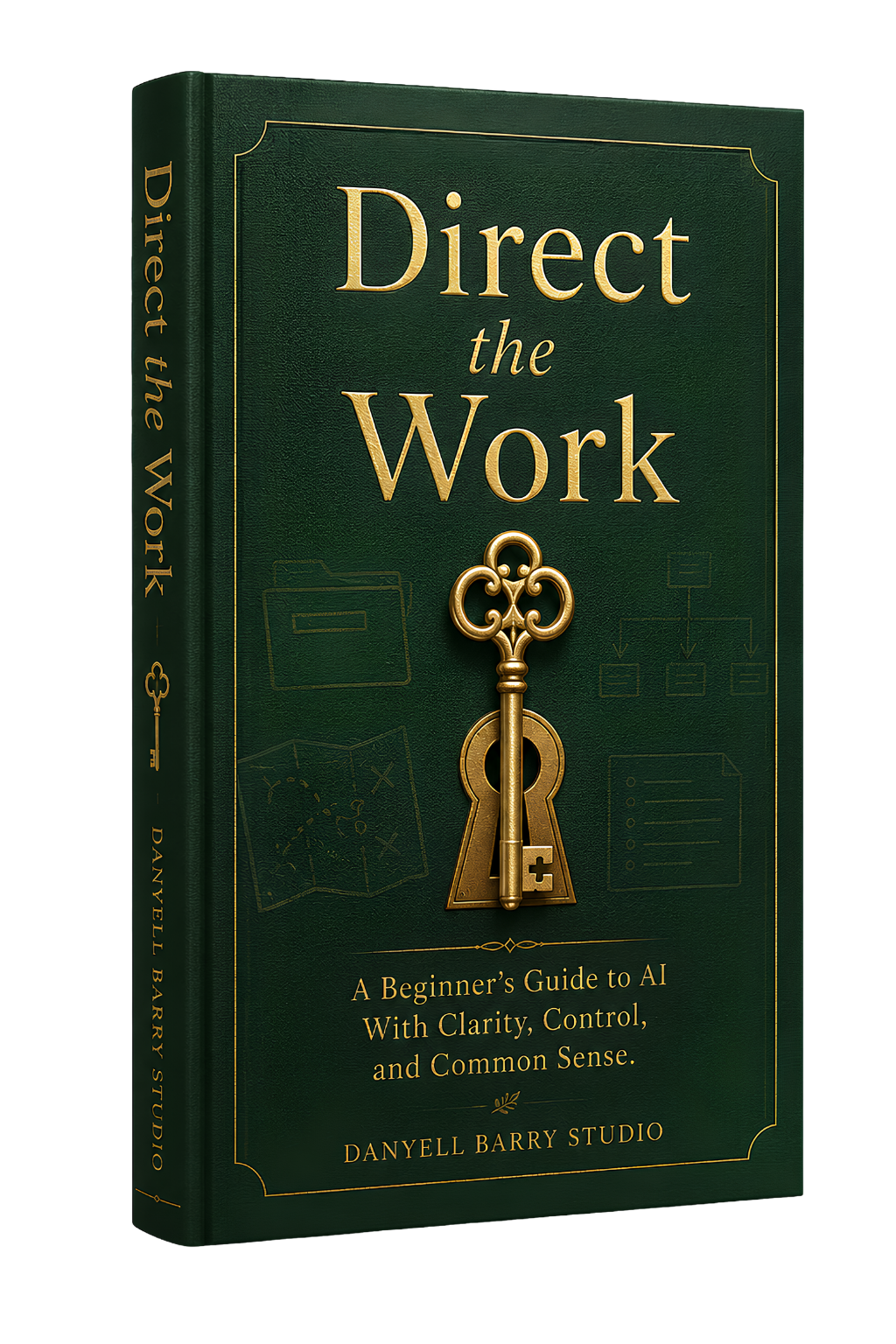
Direct the Work
A beginner-friendly guide to using AI with clarity, control, and common sense.
Not because they’re not smart enough, but because nobody taught them the part that actually matters. This book teaches that part. Six ideas. Short on purpose. You’ll be ahead of almost everyone using AI today by the time you finish.
Keep scrolling for the introduction and Chapter 1.
The book, Studio Notes essays, free tools, and curated recommendations for continuing your AI practice.
A beginner-friendly guide to using AI with clarity, control, and common sense.
Use AI with the skills you already have and leave with one practical idea for your next move.
Practical reflections on using AI, organizing your ideas, and building with more direction.
Read the introduction and first chapter below. When you finish the sample, you’ll see a button to open the full reader.
This book is short on purpose.
A lot of beginner guides about AI try to teach you everything at once. They show you fifty tools, twenty prompts, and a hundred tips. By the end you feel busy, but you don’t feel ready. You don’t actually know what to do on Monday morning.
This book does something different. It gives you six ideas. Just six. Each one is something I learned by building real things with AI: websites, tools, brands, content systems. Each one is something that, once you understand it, will save you weeks of confusion. The tools are the easy part. The thinking is what makes the tools actually work.
I’m not going to teach you every prompt I use. I’m not going to walk you through every tool. That’s what the Direct the Work Library is for. The point of this book is to give you the way of thinking. Once you have the way of thinking, the tools and the prompts make sense. Without it, no tool will save you.
One last thing before you start. The AI tools are moving fast. Claude has Skills now. ChatGPT has custom GPTs. Gemini has Gems. Most major platforms have ways to save instructions, load context, and run reusable workflows automatically. The tools are catching up to the thinking I’m about to teach you. That’s a good thing. But here’s the part most people miss: those tools are accelerators. They make the work faster — they don’t replace the work. A reusable workflow built on shaky thinking breaks the first time your situation doesn’t fit the template. The foundation in this book is what makes the modern tools actually deliver. Learn the thinking first. The tools follow.
One thing about the format you’re reading this in. The full book lives inside a reader app I built. That was intentional. The book teaches a way of thinking about AI work. Directing, verifying, shipping, pausing, treating your work as a system. Delivering the book itself as an app I built using that same thinking felt like the only honest way to ship it. If the format makes the message land harder, good. That was the point.
A few things you should know about me:
If you are new to using AI for real work, this book is for you. You should be able to read it in one sitting. When you finish, you will know more than most people who claim to be using AI.
Let’s go.
There’s a way most people use AI when they first start. They put in a request, press a button, and take whatever comes out. That’s the starting place for everyone. This book is about what comes after.
Here is the difference. There is a person who tells AI to do something and just takes whatever comes back. And there is a person who tells AI to do something, looks at what comes back, decides what is wrong with it, and then tells the AI exactly how to fix it. The first person is delegating. The second person is directing.
When you delegate to AI, you get average. Average words. Average ideas. Average everything. Because the AI does not know what makes your work yours. It only knows what most people would write. And most people are average. That is what “average” means.
When you direct AI, you stay in charge. You decide what is good. You decide what is wrong. You decide what to keep and what to throw out. The AI gives you something to react to, but you are the one who shapes it.
Here is what this looks like in real life.
When I built my faceless relationship clarity brand, I asked AI to write the description for one of the tools. The AI wrote something that sounded like every self-help website on the internet. “Discover the patterns holding you back. Transform your relationships. Live your best life.” It was technically correct. It was completely useless. It did not sound like my brand. It did not sound like anyone.
So I told the AI what was wrong. I said: too generic. I said: my brand sounds like a smart aunt who has seen everything. I said: do not use “transform” or “discover” or “best life.” I gave it three lines from another piece of writing in my voice. Then I asked again.
The second answer was much better. Not perfect. Better. I told the AI what was still wrong. I asked again. By the fourth round, I had something I could actually use.
That is directing. The first answer was a starting point. The fourth answer was the work.
If you only learn one thing from this book, learn this. AI is not a person who finishes your work for you. AI is a tool you use to make your work faster. The work is still yours. You still have to think. You still have to judge. You still have to decide.
People who treat AI as a finisher end up with content that is technically fine and completely forgettable. People who treat AI as a tool they direct end up with work that is fast, sharp, and theirs.
The rest of this book is about how to be the second kind of person.
You just read the first one. Five more wait inside.
The book teaches you to direct the work. This free 15-minute tool helps you find the work worth directing, starting from what you already do.
Try Your Job Is the ClueNo signup. Nothing saved. Just you and one good idea.